AI Benchmarks
What is AICrier?
Live AI developer news, ranked and linked to original sources.
> ▌
BENCHMARK×
SUNDAY // 2026-10-11
17 itemsOCT 11

PT1M16S
// WATCH
AI Has a Secret Phrase That Steals Keys #huggingface #cybersecurity #ai
+2
Better Stack

PT10M5S
// WATCH
Your Wi-Fi Can Detect You Through Walls. I Tested It.
+2
Better Stack

PT5M38S
// WATCH
Why DeepSeek Wants AI To Forget
+1
Two Minute Papers

PT1M44S
// WATCH
How to Keep Your Claude Limits on Screen 24/7 #ClaudeCode #Tutorial
+1
DIY Smart Code

PT1M1S
// WATCH
Why His AI Token Usage Fell Off a Cliff as a Manager
Every
PT26M10S
// WATCH
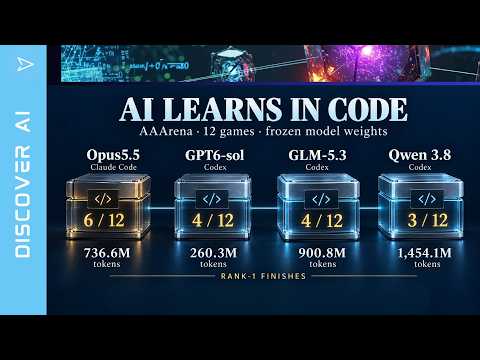
Best Open-Weight Model for Self-Learning AI: GLM 5.3
+3
Discover AI

PT14M28S
// WATCH
35 Self-Hosted Projects on GitHub: aurelio-finance, openpost, SurfSense, Reminal, Haven, maildun
+8
Github Awesome

PT10M58S
// WATCH
Google's GPT-3 Moment for Databases & Spreadsheets (TabFM)
+2
Prompt Engineering

PT1M17S
// WATCH
How LLMs Think
Better Stack
PT1M45S
// WATCH
Claude Code is deleting your history (Fix this) #ClaudeCode #DeveloperTips
+2
DIY Smart Code

PT2M25S
// WATCH
Why Your Claude Code Hooks Are Failing (And How To Fix It) #ClaudeCode #Coding #DevTools
+1
DIY Smart Code

PT15M15S
// WATCH
My Self Training Claude Code Setup: I Made Claude Code TRAIN ITSELF!
+2
AICodeKing

PT22M46S
// WATCH
China AI ACHIEVED RSI? GLM 5.5, NEW Fable 5.5 Checkpoint, Qwen4, Kimi K3.1, M3.1 Pro & More! AI NEWS
+8
WorldofAI

PT1M18S
// WATCH
Apollo 11 Code is Open-Source And Hilarious
Better Stack

PT2M54S
// WATCH
Why your closed source app isn't safe #ai #security #dev
+2
DIY Smart Code
BENCHMARK// 3h ago
Claude Opus 5.5 Wins Six AAArena Golds
Claude Opus 5.5 paired with Claude Code topped six of AAArena’s 12 human-program ladders, according to a paper submitted October 8. The benchmark measures iterative policy revision with fixed model weights, testing long-horizon agent development rather than one-shot prompting. [AAArena paper](https://arxiv.org/abs/2610.12341)
claude-opus-5-5claude-codellmcoding-agentagentevaluationbenchmark+7+6+5+4+3+2+1
BENCHMARK// 3h ago
Artificial Analysis Exposes Image-Edit Drift
Artificial Analysis tested four frontier image-editing models across 30 consecutive edits of the same photo, measuring how much of the original scene survived outside the requested changes. Ideogram 4.5 and FLUX 3 preserved at least 95% of pixels during small edits, while GPT Image 2.5 Sunburst and Nano Banana 2.1 introduced substantially more cumulative drift.
artificial-analysisbenchmarkevaluationimage-genvisionmultimodal+6+5+4+3+2+1
SATURDAY // 2026-10-10
5 itemsOCT 10

PT33S
// WATCH
Reverse Engineer Anything: #1 on GitHub
+2
Eric Michaud

PT45M12S
// WATCH
New AI enzymes, 700+ math breakthroughs, AI for DNA mutations, room temp semiconductors: AI NEWS
+10
AI Search

PT1M57S
// WATCH
The Claude setting that's secretly training AI #claudeai #security
+1
DIY Smart Code

PT2M41S
// WATCH
Cell Towers Could Soon Broadcast AI on Your Phone!
+1
Better Stack
PT13M44S
// WATCH
Google’s New CARBON Is Apparently a MONSTER
+5
AI Revolution