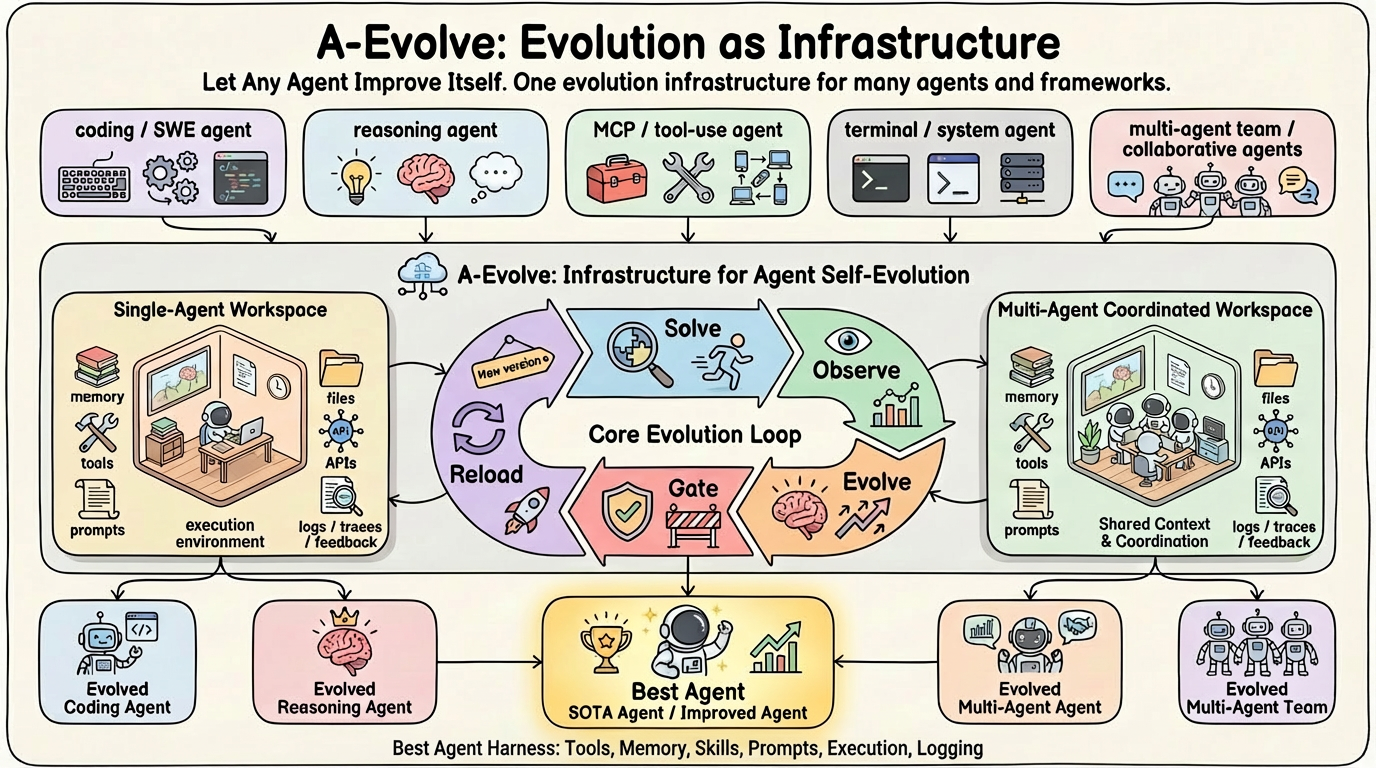
A new research study and framework, a-evolve, reveals that smaller LLM agents are surprisingly good at optimizing their own prompts and tools, but they struggle to actually benefit from them.
Developed by A-EVO-Lab, the "Harness Updating Is Not Harness Benefit" paper and accompanying open-source framework, a-evolve, explore how LLM agents self-improve by updating external "harnesses"—such as prompts, skills, memory, and tools. Through rigorous evaluation, the research disentangles two core capabilities of self-evolving agents: the ability to generate effective system updates based on execution feedback (Harness-Updating) and the ability to successfully execute tasks utilizing those updated components (Harness-Benefit). Surprisingly, the authors discover that the capacity to write high-quality workspace updates is relatively flat across model tiers, meaning that smaller models can write improvements as effectively as frontier models. However, the ability to actually benefit from these updates is non-monotonic, with mid-tier models gaining the most while weak-tier models fail to follow instructions and strong-tier models achieve high baseline performance, making external help less impactful.
While the AI community is obsessed with building ever-larger frontier models, this research proves we are massively underutilizing smaller models that possess surprisingly mature meta-cognitive capabilities. If a 9B model can generate prompts and tools as effectively as a frontier model, the real bottleneck for agentic self-evolution isn't intelligence—it's execution and adherence.
* Separation of Concerns: By decoupling "writing the rules" from "following the rules," a-evolve highlights a design flaw in current single-agent architectures and points toward multi-agent hierarchies as the optimal path forward.
* The Mid-Tier Sweet Spot: The finding that mid-tier models benefit most from updated harnesses suggests that self-evolution yields the highest return on investment for cost-effective, task-specific models rather than expensive frontier LLMs.
* Leveraging Cheap Intelligence: We can now build hybrid agentic workflows where lightweight, inexpensive models continuously optimize workspaces, saving expensive frontier models exclusively for the final execution of complex tasks.
DISCOVERED
136d ago
2026-06-02
PUBLISHED
136d ago
2026-06-02
RELEVANCE
AUTHOR
Discover AI