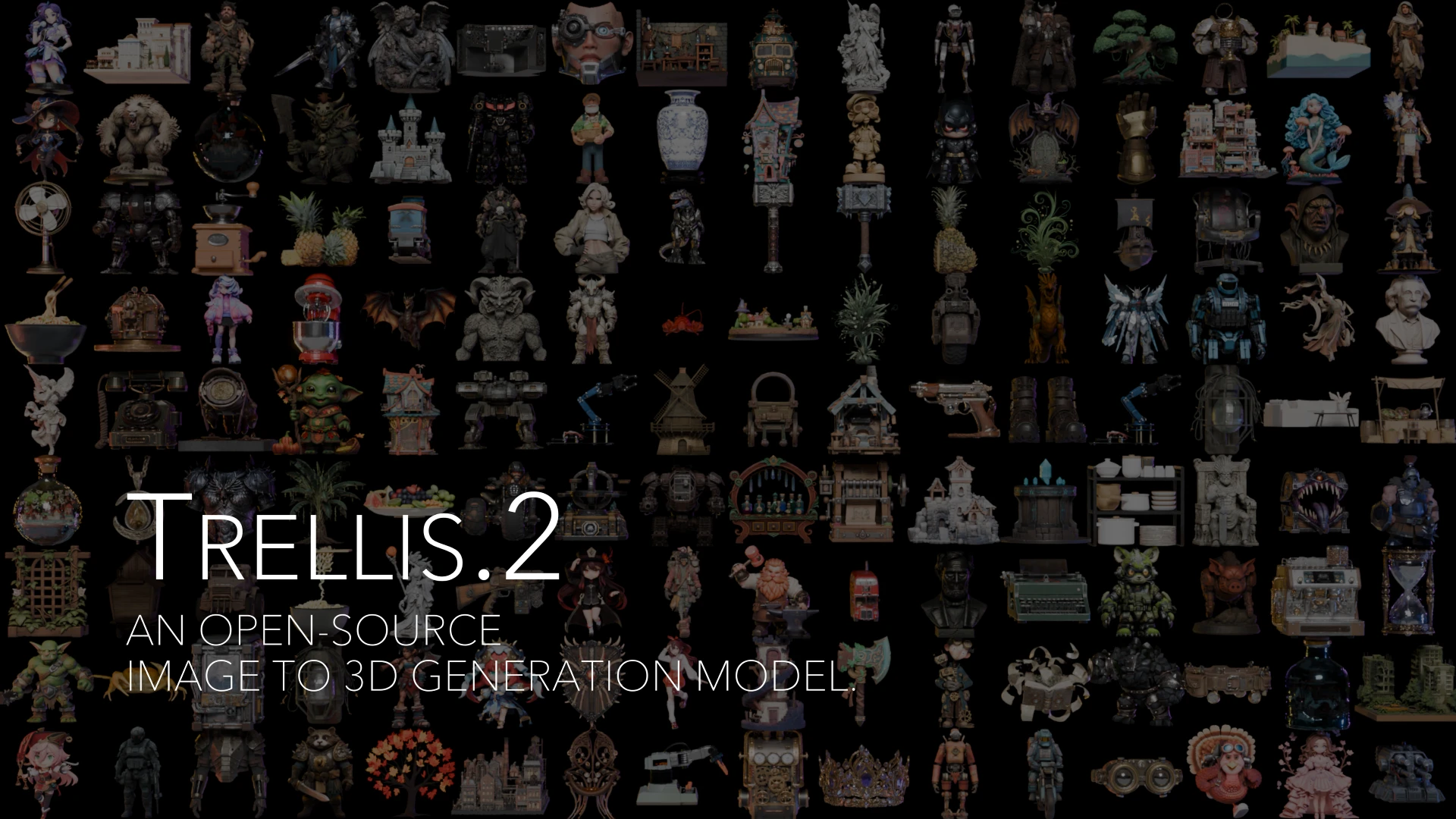
Hugging Face details TRELLIS.2 LoRA fine-tuning
Hugging Face published an end-to-end guide and containerized pipeline for fine-tuning Microsoft's TRELLIS.2 3D generation model using LoRA. By targeting the sparse-structure and shape flow DiTs while freezing texture generation, developers can adapt 3D generation to custom asset categories in 12 hours with under 200 samples.
3D generation has lagged far behind 2D image models in accessible customization, but targeted LoRA adapters finally make domain adaptation practical for indie devs and studios. Freezing texture flow while adapting sparse-structure and shape DiTs provides an efficient blueprint for fixing category-specific geometry errors without catastrophic forgetting.
- –Resource efficiency: Requiring just 188 footwear samples and 12 hours on a single A100 (80GB) lowers the barrier to entry from industrial-scale compute to accessible cloud jobs.
- –Architectural separation: Training only ~9.3M parameters across rank-8 and rank-16 LoRA adapters preserves TRELLIS.2's generalist priors while correcting specific geometry flaws like shoe soles.
- –Turnkey workflow: Hugging Face provides dual Docker containers for xvfb/Blender multi-view preprocessing and training, supporting both Hugging Face Jobs and local execution.
- –Selective freezing is essential: Freezing the texture flow DiT avoids corrupting materials when using real-world captures with baked-in lighting, highlighting the nuances of 3D data hygiene.
DISCOVERED
3h ago
2026-11-16
PUBLISHED
4h ago
2026-11-16
RELEVANCE
AUTHOR
michaelgold