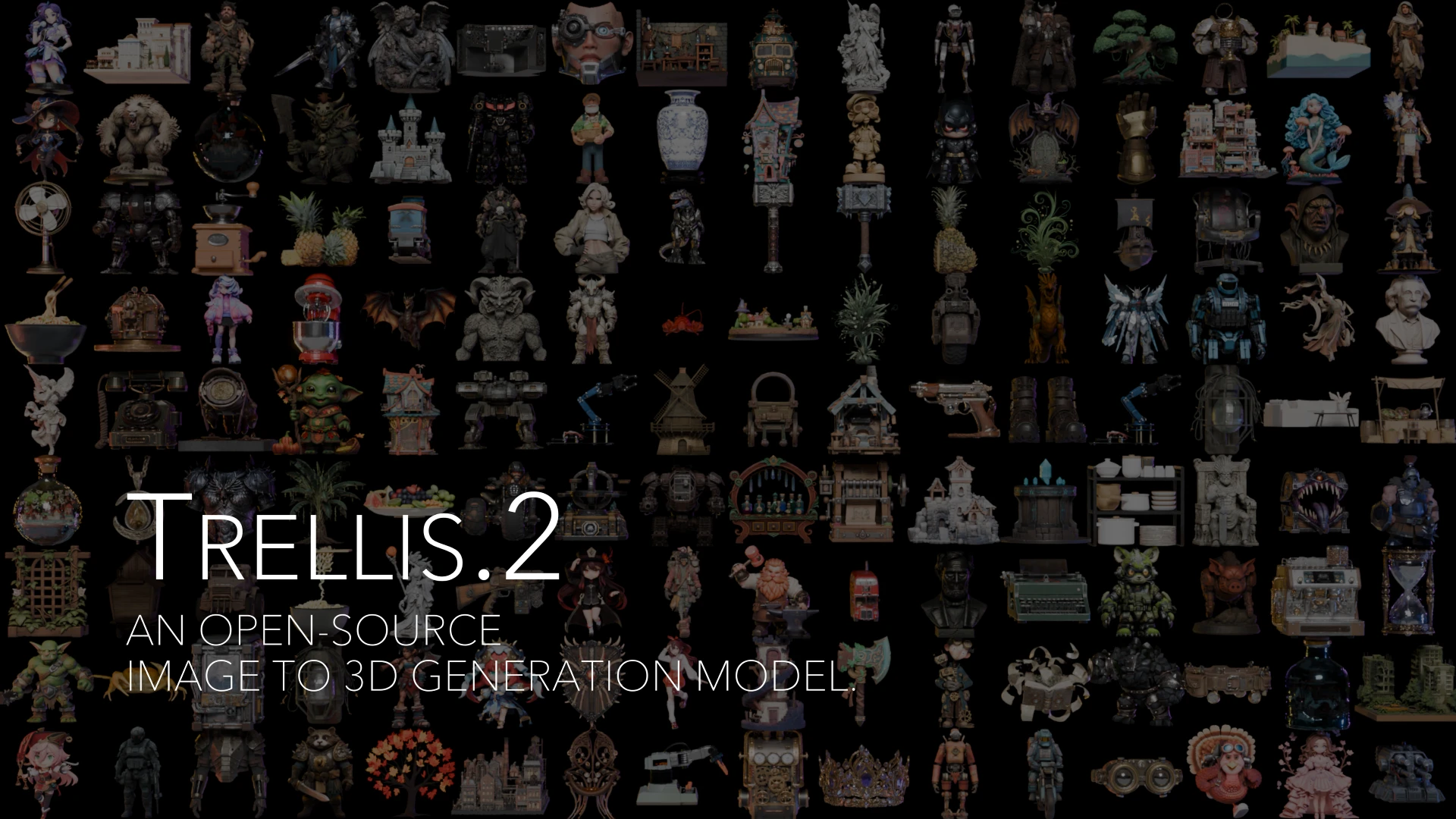
Microsoft has open-sourced TRELLIS.2, a 4B parameter model capable of transforming single images into high-fidelity, production-ready 3D assets in mere seconds.
Microsoft Research has released TRELLIS.2, an advanced open-source generative AI model that bridges the gap between 2D imagery and usable 3D assets. By utilizing a 4-billion parameter flow-matching transformer and an innovative field-free "O-Voxel" representation, the model achieves high-fidelity generation, complete with physically based rendering (PBR) materials like base color, roughness, and opacity. Capable of handling complex geometries such as hair and thin structures, TRELLIS.2 scales its performance, generating assets at 512³ resolution in approximately 3 seconds on high-end hardware, with support up to 1536³ for maximum detail.
This release represents a significant advancement in 3D content creation, specifically by moving away from traditional, often error-prone iso-surface field approaches.
* Performance: The speed of generating textured meshes in seconds is a massive boon for rapid prototyping, game asset creation, and design workflows.
* Fidelity: The native support for PBR materials directly within the generative process drastically reduces post-processing cleanup, a major bottleneck in current image-to-3D pipelines.
* Scalability: The structured latent approach, which compresses massive voxel volumes into compact tokens, demonstrates an efficient path toward running high-fidelity 3D generation locally without requiring massive compute resources for inference.
DISCOVERED
1h ago
2026-11-18
PUBLISHED
2h ago
2026-11-18
RELEVANCE
AUTHOR
0x0SojalSec