OPEN LINK ↗
// 91d agoRESEARCH PAPER
LLM agents face sudden world-model collapse
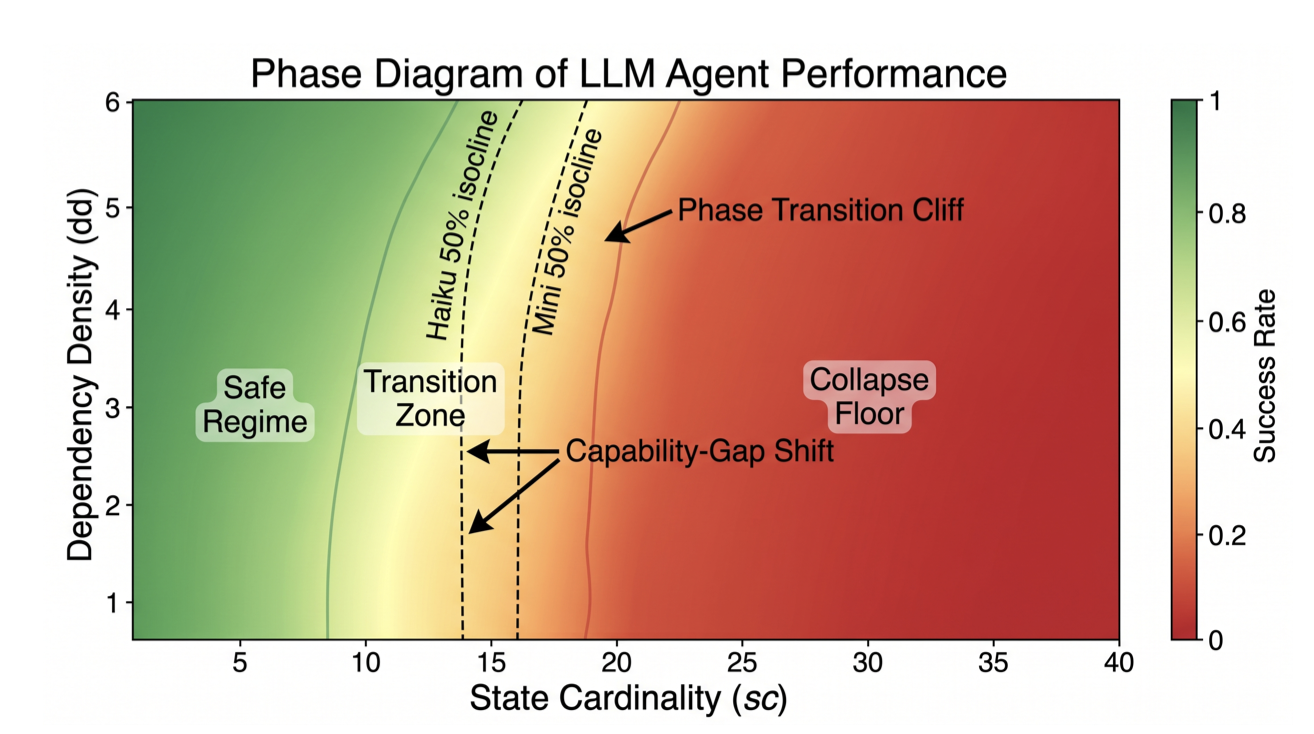
This study reveals that long-horizon LLM agents experience sudden world-model collapse as task complexity increases, even while continuing to output fluent reasoning. To support these findings, the authors released an experimental framework to simulate and map these transitions.
// ANALYSIS
Long-horizon agent reliability is not a gradual curve but a cliff, meaning testing in simplified environments is a poor predictor of real-world success.
- –Sudden collapse: LLM agents perform near-perfectly until hitting a critical threshold of state cardinality, causing sudden, catastrophic failure.
- –Silent failures: The model's reasoning and action syntax remain perfectly fluent post-collapse, making failures hard to detect without active state tracking.
- –State bottleneck: Degradation of internal world-state representation happens before actions become invalid, proving that monitoring state fidelity is crucial.
// TAGS
llm-agentsworld-model-collapsephase-transitionslong-horizon-planningagent-evaluationresearch
DISCOVERED
91d ago
2026-07-02
PUBLISHED
91d ago
2026-07-02
RELEVANCE
8/ 10
AUTHOR
Discover AI