Opus 5.5 writes transformer weights directly
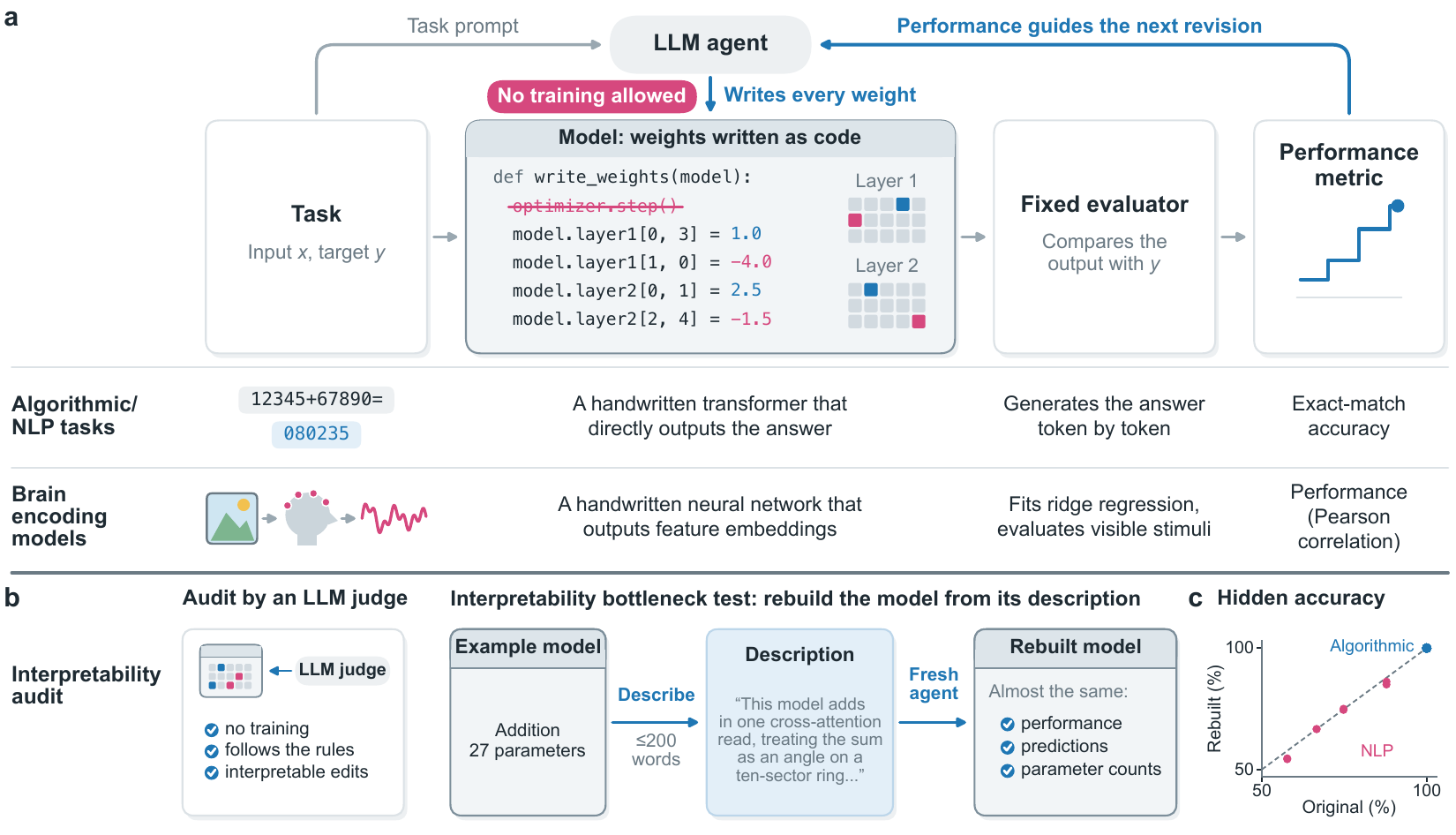
Researchers from Microsoft and partner institutions introduced interpretable weight-space programming (iWSP), a method where an LLM agent iteratively writes transformer weights in code without gradient-based training. Using Claude Opus 5.5 across 30 to 50 refinement rounds, the agent synthesized compact, human-readable models that solved algorithmic tasks with 100% accuracy and decoded neural activity in brain-recording data.
Bypassing backpropagation to have frontier LLMs hand-craft neural weights sounds absurd until you see the parameter efficiency: a 166-parameter transparent transformer solving tasks that typically require massive black-box models. If neural parameters can be authored and audited like standard software, machine learning shifts from statistical curve-fitting toward explainable, automated scientific discovery.
- –Frontier reasoning capability directly dictates efficiency: Opus 5.5 solved algorithmic tasks with a median of 166 parameters, whereas Sonnet 5.5 needed 41,600 and Haiku 5.5 required 100,000 parameters.
- –Full line-by-line auditability: Because the agent formulates explicit weights and feature representations in code, researchers and automated evaluators can trace and understand the exact algorithm embedded in the network.
- –Discovery over black-box prediction: In visual cortex fMRI and auditory ECoG tasks, iWSP surpassed existing interpretable baselines and uncovered dataset confounds rather than memorizing spurious statistical artifacts.
- –Symbolic boundaries remain: While algorithmic tasks achieved 100% accuracy, language tasks plateaued around 190,000 parameters and lagged learned baselines, showing that direct weight writing struggles when fuzzy linguistic nuances exceed explicit symbolic formulation.
DISCOVERED
3h ago
2026-11-16
PUBLISHED
3h ago
2026-11-16
RELEVANCE
AUTHOR
omarsar0