tiny-voca drops 18MB local CPU TTS
Muhammed Nazeem released tiny-voca, an open-source 4.5M-parameter text-to-speech model that runs 70x faster than real-time on CPU threads and executes in-browser via ONNX Runtime Web. Trained entirely on synthetic audio generated by Qwen3-TTS without any human voice recordings, it replaces heavy neural vocoders with a lightweight DSP source-filter synthesizer to fit the full pipeline into 18 MB.
Replacing heavy neural vocoders with classic source-filter DSP proves that edge text-to-speech does not require gigabyte-scale weights or dedicated GPUs to sound natural. Training solely on synthetic Qwen3-TTS audio also establishes a practical, legally clean template for distilling larger voice architectures into hyper-specialized edge models.
- –Ultra-compact footprint: At 4.5M parameters (18 MB PyTorch / 21 MB ONNX), tiny-voca includes the waveform synthesizer and runs 70x faster than real-time on four CPU threads or directly inside web browsers.
- –Source-filter synthesis: Replaces neural vocoders with a 26k-parameter module that shapes pitch-driven pulse trains and noise through predicted filter cepstra, eliminating a massive inference bottleneck.
- –Synthetic-only training: Trained on 19 hours of audio generated by Qwen3-TTS VoiceDesign and screened by Whisper, sidestepping human voice licensing and consent hurdles entirely.
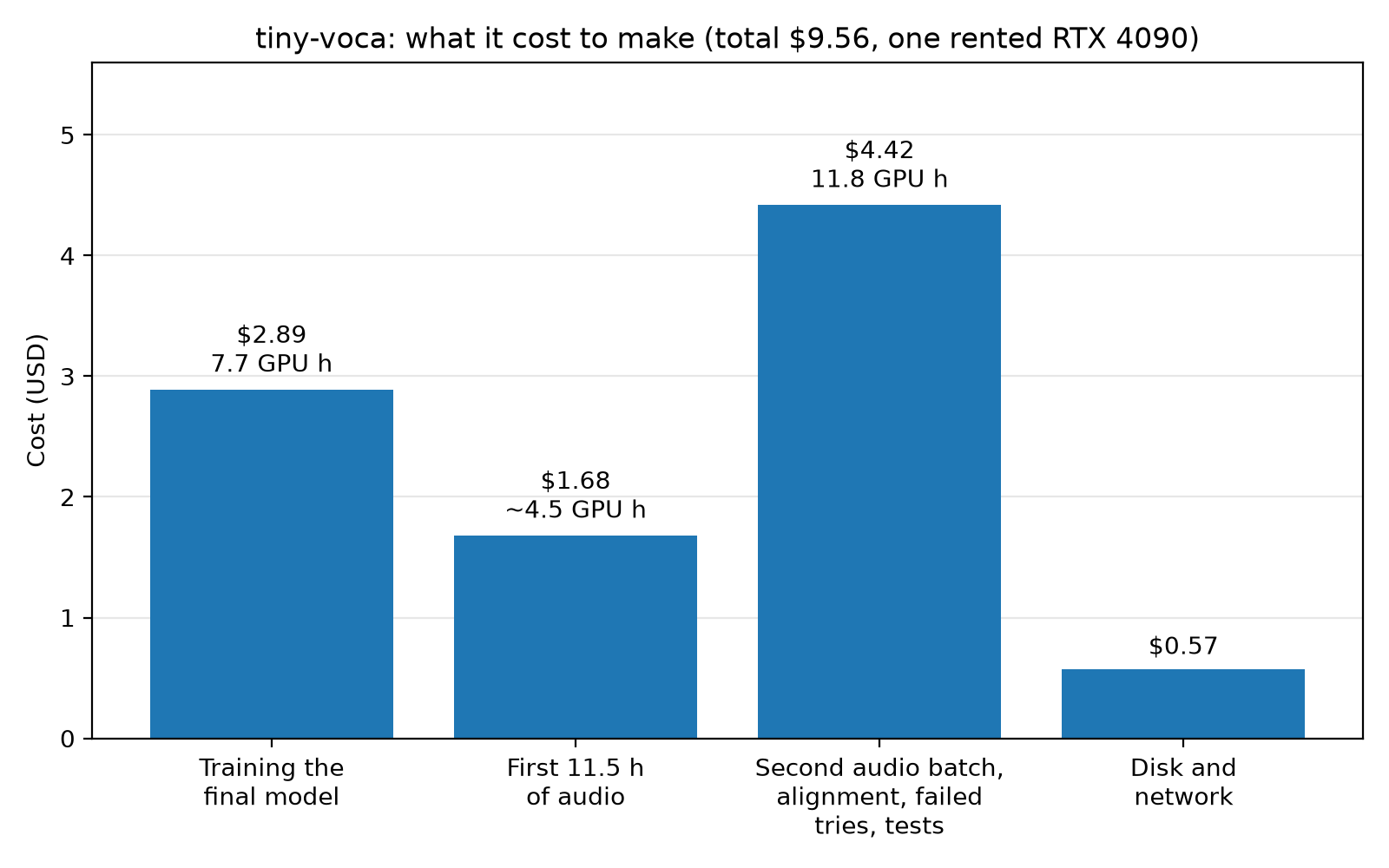
- –Commodity training cost: The complete two-phase adversarial training run finished in just 7.7 hours on a single consumer RTX 4090 GPU.
- –Edge developer trade-offs: Fixed to two American English voices without zero-shot cloning, making it ideal as an embedded voice engine for local-first assistants and games rather than voice studios.
DISCOVERED
14m ago
2026-11-16
PUBLISHED
43m ago
2026-11-16
RELEVANCE
AUTHOR
0x0SojalSec