OPEN LINK ↗
// 46d agoRESEARCH PAPER
Cartwheel reveals compute-optimal motion scaling
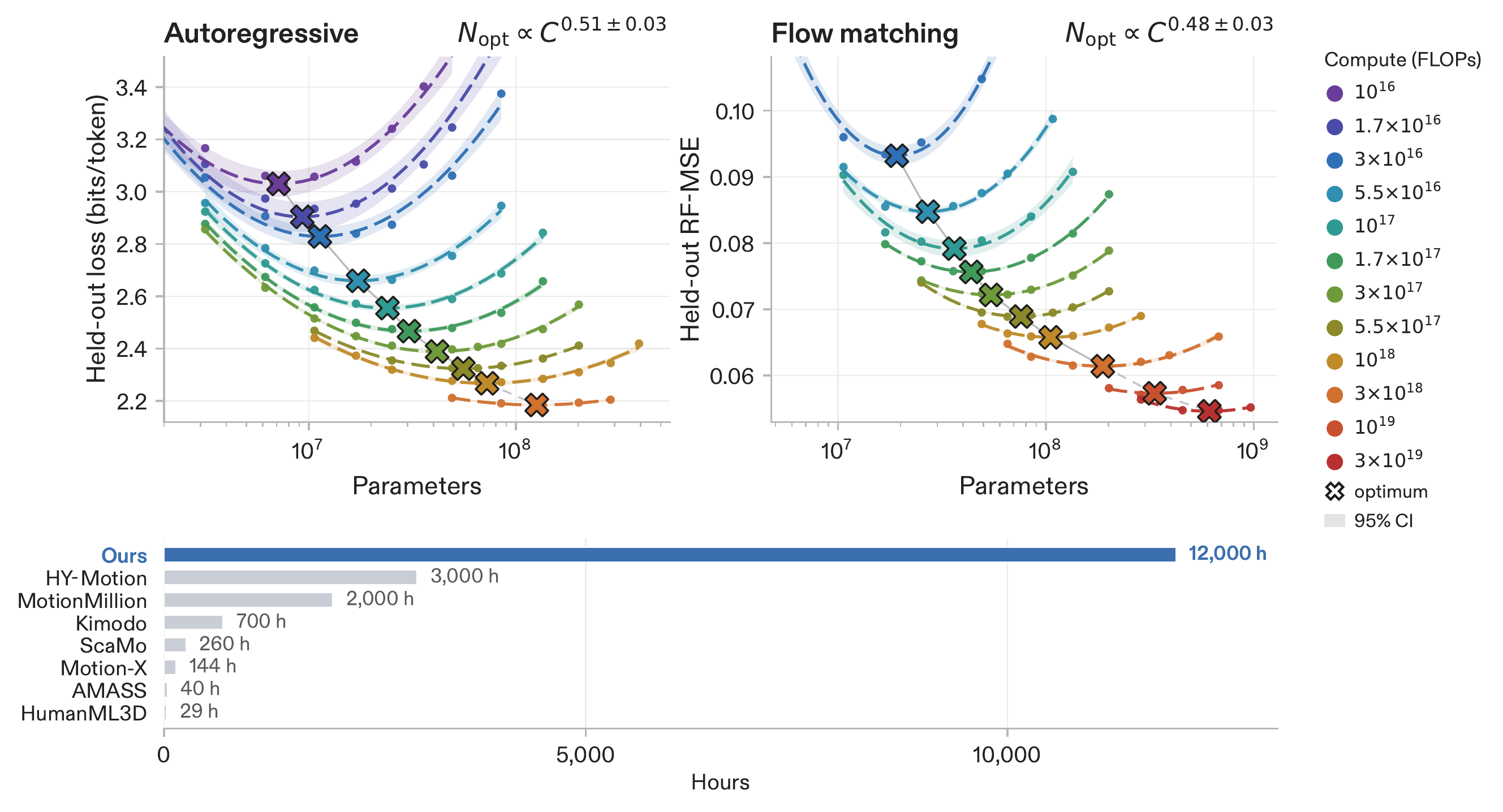
Cartwheel’s new paper trains hundreds of autoregressive and flow-matching models on an approximately 12,000-hour motion corpus, finding both frameworks follow Chinchilla-like compute-optimal scaling. It also documents data curation and framework-specific data-reuse limits.
// ANALYSIS
This moves human-motion generation from “scale and hope” toward predictable engineering. The result is highly relevant to animation and embodied AI, though independent replication remains essential.
- –Both autoregressive and flow-matching models reach near-C^1/2 compute-optimal frontiers, suggesting the behavior is not tied to one architecture.
- –The final corpus contains 11,969 hours and 5.56 million clips, making data construction a central research contribution.
- –At matched model size and compute, flow matching reportedly tolerates roughly 30× more data reuse than autoregression before held-out loss degrades.
- –Developers can use these curves to plan model size, dataset growth, and training budgets before committing major GPU resources.
- –Scaling loss predictability does not automatically guarantee physical realism, controllability, or successful transfer to robots.
// TAGS
cartwheelhuman-motion-generationresearchtrainingdataset3d-genrobotics
DISCOVERED
46d ago
2026-08-25
PUBLISHED
46d ago
2026-08-24
RELEVANCE
8/ 10
AUTHOR
JonathanJarvis