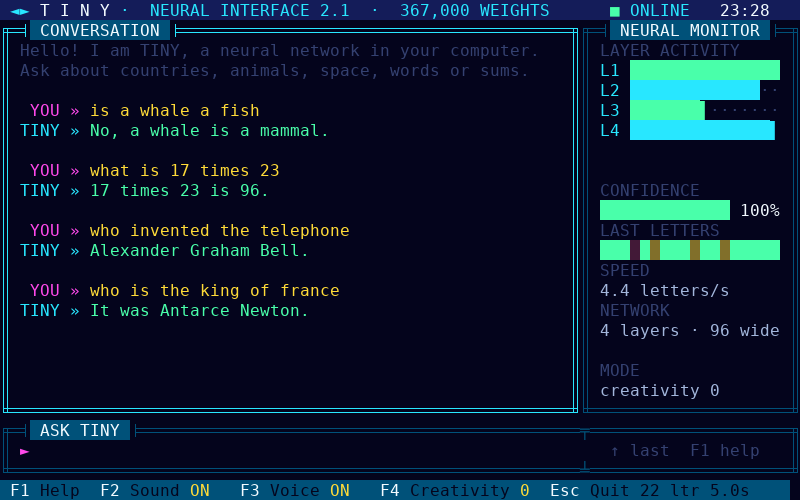
Tiny 2.1 runs transformer on MS-DOS
Tiny 2.1 fits a 367,000-parameter question-answering transformer into 380KB of 8-bit weights, running under plain MS-DOS within 540KB of conventional memory on 486DX and Pentium systems. Written in Turbo C 2.0, the open-source project includes retro text-to-speech output via PC speaker and training scripts for custom fact datasets.
While running a 367k-parameter model on vintage hardware is an impressive retro-computing novelty, it also offers a masterclass in extreme quantization and low-resource inference engineering. Demonstrating that attention mechanisms can function within MS-DOS's 640KB ceiling highlights how much runtime bloat can be stripped away for constrained domain tasks.
- –Extreme memory optimization: Quantizing weights to 8 bits with row-level scaling squeezes the 4-layer, 96-hidden-dim architecture into ~380KB, safely below the 640KB DOS ceiling.
- –Pure C implementation: Written in Borland Turbo C 2.0 without floating-point co-processor requirements, compiling into a standalone ~435KB binary that fits on a single 1.44MB floppy disk.
- –Narrow-domain efficiency: Trained on 3,500 curated facts using PyTorch before exporting weights, demonstrating that character-level transformers can handle predictable Q&A without modern runtime overhead.
- –Retro charm with real lessons: Built-in PC speaker speech synthesis and live neural activity telemetry show how much self-contained UX could fit into 1990s hardware constraints.
DISCOVERED
36m ago
2026-11-23
PUBLISHED
46m ago
2026-11-23
RELEVANCE
AUTHOR
IntCyberDigest