OPEN LINK ↗
// 1h agoRESEARCH PAPER
Latent Sparse Attention Makes 10M Tokens Practical
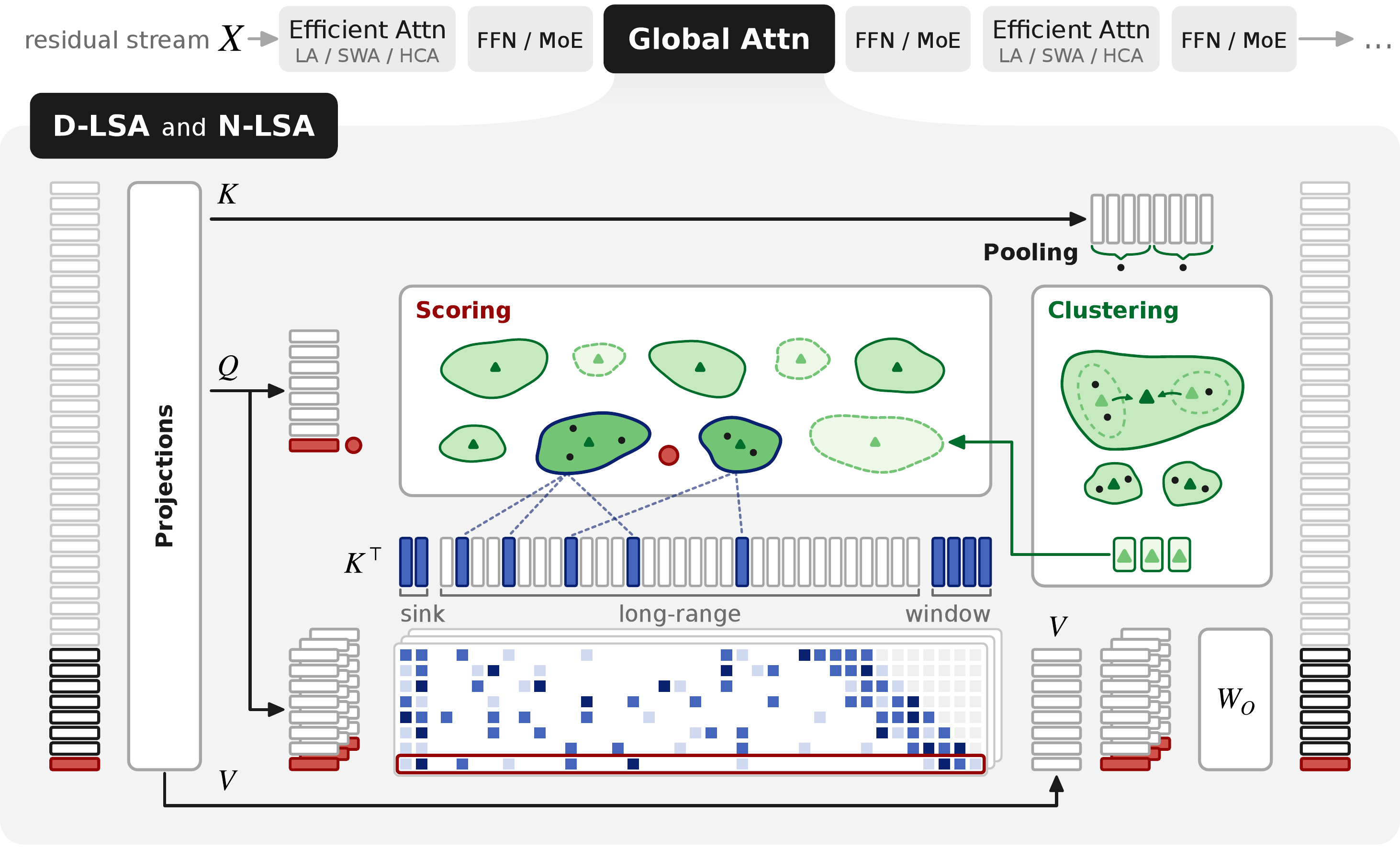
Latent Sparse Attention hierarchically clusters keys in learned latent space, replacing expensive token-by-token search with subquadratic retrieval. Its distilled variant delivers up to 22.7x faster prefill on GLM and 72.4x on Qwen at 10M tokens, while preserving comparable accuracy.
// ANALYSIS
LSA targets the overlooked bottleneck in sparse attention: finding relevant keys can cost more than reading them. The results are promising, but headline layer-level gains should not be confused with whole-model speedups.
- –Distilled-LSA adapts pretrained models, making the technique more deployable than approaches requiring full retraining.
- –Reported gains reach 4.6x–42.5x during decode, where long-context serving costs are especially painful.
- –Whole-model serving improvements are smaller because feed-forward and other layers remain unchanged.
- –Qwen is compared against full attention, while GLM is compared against an existing sparse baseline, so the headline numbers are not directly apples-to-apples.
- –Native-LSA matches full-attention accuracy in a 128K-token, roughly 0.5B-parameter training experiment, leaving larger-scale validation open.
// TAGS
latent-sparse-attentionllmlong-contextinferenceopen-sourceresearchbenchmark
DISCOVERED
1h ago
2026-11-03
PUBLISHED
1h ago
2026-11-03
RELEVANCE
9/ 10
AUTHOR
GitGem